Meta Ads Creative Testing: How to Test Concepts, Not Tweaks
By Mohd Altamash ·
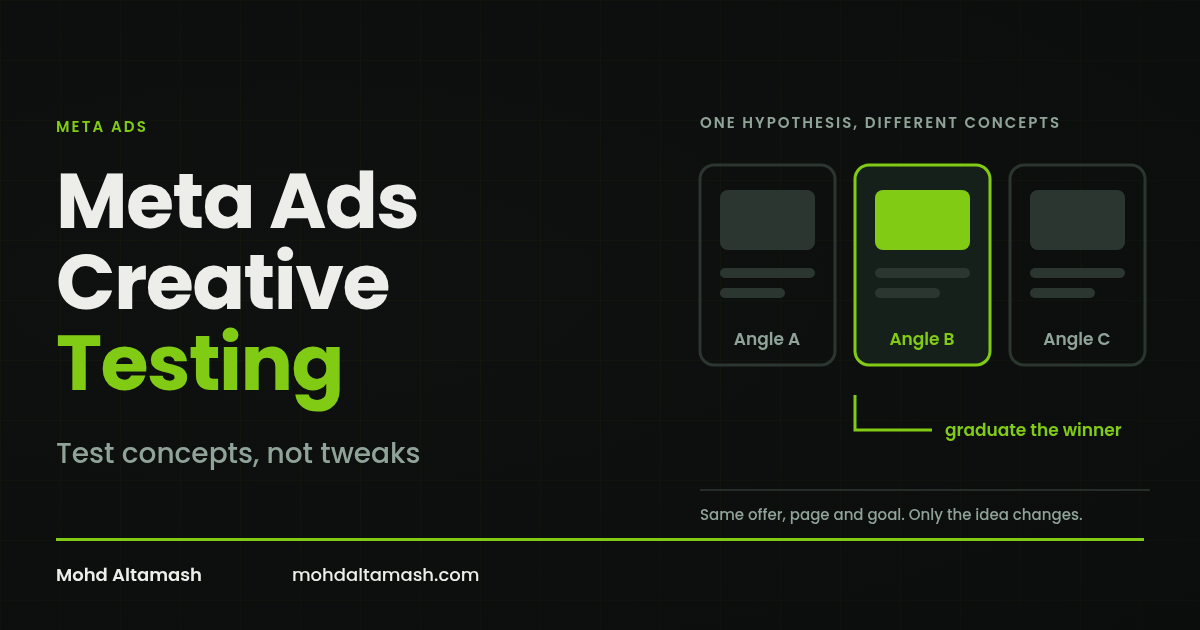
Creative testing for Meta ads works best when you treat creative as your main targeting lever. Test genuinely different concepts rather than small tweaks, use AI to produce variations of ideas that already show promise, and refresh or retire ads when fatigue appears. Document every result so your learning compounds.
I have spent 16+ years in digital marketing and managed ₹750 Crore+ in ad spend across 100+ brands. The lessons below are the principles I rely on in any Meta ads creative test, whatever the category or budget. They are not formulas, and none of them replaces testing in your own account.
Why is creative now the main targeting lever on Meta?
A few years ago, most of the work in a Meta account went into building audiences: interest stacks, lookalikes and exclusions. Two changes weakened that approach.
• Signal loss. Apple's App Tracking Transparency, introduced with iOS 14.5 in April 2021, let people opt out of cross-app tracking. Platforms lost much of the behavioural data that detailed targeting relied on.
• Automation. Meta has steadily moved advertisers towards broad, machine-led delivery through its Advantage+ campaign options.
Meta now says this directly. Its April 2025 article on creative diversification and Meta Andromeda — https://www.facebook.com/business/news/the-creative-advantage-unlocking-the-power-of-diversification-with-meta-andromeda describes a shift "from niche targeting to creative diversification as the best lever to find the most relevant audiences". Andromeda — https://engineering.fb.com/2024/12/02/production-engineering/meta-andromeda-advantage-automation-next-gen-personalized-ads-retrieval-engine/, introduced in December 2024, is the retrieval system that helps decide which ads are considered for each person. A wider range of creative gives it more options to work with.
In practice, your creative does the targeting. A video that opens with "back pain after long office shifts" reaches different people from one that opens with "recovering faster after a marathon", even with the same product, budget and settings. That is why the ideas you put into an account now matter more than the audience settings around them.
Concepts vs tweaks: what should you actually test?
A tweak is a small change to an existing ad: a button colour, a reworded headline, a new background. A concept is a different reason to care: a new angle, promise, format or customer problem.
Tweaks usually produce small differences that realistic budgets cannot separate from random noise. You spend money and learn little. Concepts produce larger swings, which are easier to detect and teach you something about your customer.
The four variables worth testing
• Angle: the core reason to buy, such as saving time, saving money, status, safety or convenience.
• Hook: the first seconds of a video, or the first line of copy, that earn attention.
• Format: static image, short video, carousel, creator-style, founder-to-camera or product demo.
• Proof: reviews, demonstrations, expert explanation or comparison. All of it must be genuine.
Example: a concept test vs a tweak test
Say you sell an ergonomic office chair.
• Tweak test: the same video with a blue button against a green button. The difference, if any, will likely be too small to read.
• Concept test: three ads built on different angles. One leads with back pain after long workdays, one with focus and productivity, one with a side-by-side comparison against a standard chair. Whichever wins tells you which problem your buyers care about most.
How do you structure a creative test in Meta Ads Manager?
This is the process I follow for creative testing for Meta ads campaigns:
• Write one hypothesis per test. For example: "Customers respond more to the time-saving angle than the price angle." If you cannot state what you are testing, you cannot learn from it.
• Ring-fence a testing budget as a fixed line item, separate from your scaling budget.
• Keep conditions comparable. Hold the offer, landing page, conversion goal and timeframe steady. Otherwise a better discount may be mistaken for a better idea.
• Choose the success metric before launch. Use the metric closest to revenue that you measure reliably, such as cost per purchase or cost per qualified lead.
• Set a decision threshold in advance. Agree how many conversions and how long a period you need before calling a result. Meta's learning phase — https://www.facebook.com/business/help/112167992830700 guidance, roughly 50 optimisation events in a week, is a reminder that small numbers are unstable.
• Graduate winners. Move proven concepts into your main campaigns and keep testing new ones in parallel.
Using Meta's built-in creative test feature
Meta Ads Manager now includes a creative test — https://www.facebook.com/business/help/1423851372208214 feature that compares up to seven new ad variants inside an existing campaign. It requires the Highest volume bid strategy, Meta suggests using no more than 20% of the campaign budget, and results do not include a confidence level.
Treat it, and any ordinary campaign comparison, as directional. A 2019 study in Marketing Science by Gordon and colleagues — https://pubsonline.informs.org/doi/10.1287/mksc.2018.1135 found that observational methods often failed to match the results of large Facebook experiments. Do not call an uncontrolled comparison a clean experiment.
How can AI help with creative testing without making every ad look the same?
AI is most useful when a person chooses the concept and AI helps produce variations of it. I use it for:
• Generating hook and headline options for a proven angle.
• Drafting video scripts and briefs from one strategic idea.
• Resizing and reformatting assets for different placements.
• Localising copy into Hindi, Hinglish or regional languages, with a native speaker reviewing it.
• Summarising comments, reviews and support tickets to find angles in customers' own words.
Meta also offers generative AI tools within Advantage+ creative, and their features change often. I cover the wider picture in my guide to AI in performance marketing — https://mohdaltamash.com/blog/ai-in-performance-marketing, and where agents fit in AI agents for marketing — https://mohdaltamash.com/blog/ai-agents-for-marketing.
The main risk is sameness. When everyone prompts the same tools the same way, ads start to look alike and are easy to scroll past. Keep human judgement on strategy, voice and claims. AI may reword a verified benefit, but it must never invent a testimonial, endorsement, demonstration or before-and-after result. The NIST AI Risk Management Framework — https://www.nist.gov/itl/ai-risk-management-framework (2023) is a useful reminder to check validity and risk before anything is published.
Today's tools are AI, not superintelligence. Whether and when superintelligence arrives is a matter of expert opinion, and estimates vary widely. I explore that question in what superintelligence means for marketers — https://mohdaltamash.com/blog/what-superintelligence-means-for-marketers. For now, AI speeds up production, but deciding which ideas are worth testing is still the marketer's job.
How do you know when a Meta ad creative is fatigued?
Every ad eventually wears out. Meta Ads Manager can show creative fatigue recommendations — https://www.facebook.com/business/help/1346816142327858, labelled "Creative limited" or "Creative fatigue" in the Delivery column, when an ad's cost per result rises well above what similar past ads achieved.
Alongside that, compare each ad with its own earlier performance. Watch for:
• Frequency rising while click-through rate falls.
• Cost per result rising over several periods, not one bad day.
• Fewer viewers watching past the opening seconds of a video.
• Comments such as "I keep seeing this ad".
Refresh before you retire
Before blaming the creative, rule out tracking problems and changes to price, stock, offer or landing page. A Conversions API setup — https://mohdaltamash.com/blog/meta-conversions-api-setup that sends clean events is the first thing to confirm, and the Meta Ads breakdown reports — https://mohdaltamash.com/blog/meta-ads-breakdown-reports show whether the drop sits in one placement, audience or ad. Then put a new hook or format on the same concept. If the refresh also declines quickly, retire the concept for now, but keep it on record. Ideas sometimes work again later.
Why should you document every creative test result?
Without documentation, testing becomes an expensive cycle of forgetting, and teams retest the same ideas. Keep a simple creative library that records:
• Concept, angle, hook and format.
• Hypothesis and success metric.
• Dates, spend and outcome.
• What stayed constant during the test.
• Your best explanation of why it won or lost.
Record losers too, and write conclusions narrowly. "This demo deserves another test for this problem" is more defensible than "demo videos always win".
What lessons hold up when you scale creative testing?
• Range beats polish. A steady flow of different ideas usually outperforms a few highly produced ads.
• The opening decides most outcomes. If the first seconds do not earn attention, the rest barely matters.
• Native often beats perfect. Ads that look at home in the feed frequently beat ads that look like commercials. Test both.
• Let data decide. The favourite ad in a meeting is not always the customer's favourite.
• Do not stop tests too early. Early results are noisy, so stick to thresholds set before launch.
• Creative and offer work together. A great ad cannot fully rescue a weak offer or a poor landing page.
Key takeaways
• With signal loss and automated delivery, creative is the main targeting lever on Meta, and Meta now says so.
• Test distinct concepts (angle, hook, format, proof), not small tweaks.
• Set a hypothesis, budget, metric and threshold before every test.
• Use AI for variations of human-chosen concepts, never for invented proof.
• Diagnose fatigue against each ad's own baseline, and refresh before you retire.
• Document winners and losers so learning compounds.
FAQ
What is creative testing for Meta ads?
It is the structured process of running different ad concepts against each other on Facebook and Instagram to learn which angles, hooks, formats and proof drive results. Each test has a hypothesis, a fixed budget, a success metric and a decision threshold set before launch.
How many creatives should I test at once in Meta ads?
Fewer, more different ads. A small set of distinct concepts, each with enough budget to reach your conversion threshold, teaches more than many near-identical ads that each get too little spend.
How long should a creative test run?
Until it reaches the conversion threshold you set in advance, not a fixed number of days. Most tests should also cover at least a full week, because weekday and weekend behaviour can differ.
Is CTR a good metric for picking a winning creative?
CTR is a useful early signal of attention, but some ads attract clicks from people who never buy. Pick winners on the metric closest to revenue, such as cost per purchase or cost per qualified lead.
Can AI-generated creatives perform as well as human-made ones?
They can, especially when AI creates variations of a concept a person has chosen and checked. Results vary by brand and audience, so test AI-assisted and human-made creatives against each other.
When should I retire a Meta ad creative?
Retire it when a refreshed version of the same concept, with a new hook or format, also declines quickly. Before that, rule out tracking, offer, price and landing page changes, and compare the ad with its own earlier performance.
Sources
• Meta for Business, The Creative Advantage: Unlocking the Power of Diversification with Meta Andromeda — https://www.facebook.com/business/news/the-creative-advantage-unlocking-the-power-of-diversification-with-meta-andromeda, April 2025.
• Engineering at Meta, Meta Andromeda: Supercharging Advantage+ automation — https://engineering.fb.com/2024/12/02/production-engineering/meta-andromeda-advantage-automation-next-gen-personalized-ads-retrieval-engine/, December 2024.
• Meta Business Help Center, Set up a creative test in Meta Ads Manager — https://www.facebook.com/business/help/1423851372208214.
• Meta Business Help Center, Creative fatigue recommendations in Meta Ads Manager — https://www.facebook.com/business/help/1346816142327858.
• Meta Business Help Center, About the learning phase — https://www.facebook.com/business/help/112167992830700.
• Gordon, Zettelmeyer, Bhargava and Chapsky, A Comparison of Approaches to Advertising Measurement: Evidence from Big Field Experiments at Facebook — https://pubsonline.informs.org/doi/10.1287/mksc.2018.1135, Marketing Science, 2019.
• NIST, AI Risk Management Framework — https://www.nist.gov/itl/ai-risk-management-framework, 2023.
About the author
Mohd Altamash is a performance marketing and AI strategist with 16+ years in digital marketing. He has managed ₹750 Crore+ in ad spend across 100+ brands, and works on paid ads on Meta and Google, AI, marketing automation and answer engine optimization. More about Mohd Altamash — https://mohdaltamash.com/about.