AI Agents for Marketing: A Practical Guide to AI Marketing Agents
On this page
- What are AI agents, and how are they different from chatbots?
- What are the steps between chatbots and superintelligence?
- Where do AI agents help marketers today?
- What can't AI agents do reliably yet?
- What does a practical AI marketing stack look like?
- 1. Data and metric definitions
- 2. An AI assistant chosen by testing
- 3. Automation and orchestration
- 4. Channel-native automation
- 5. Permissions and tool access
- 6. Review, logs and a stop switch
- How do you deploy your first AI agent for marketing?
- How do AI agents connect to AGI and superintelligence?
- Key takeaways
- FAQ
- Work with me
Key takeaway
AI agents for marketing are AI systems that plan and carry out multi-step tasks using tools, rather than just replying to a prompt. Today they work best on narrow, checkable workflows such as reporting, research, content operations and lead follow-up. A person should still approve anything that touches budgets, customers or public claims.
I have spent 16+ years in digital marketing, and few words have been stretched as far as "agent". Some tools sold as AI marketing agents are simple automations with a chatbot attached. Others can genuinely research, decide and act across several systems. Gartner calls the relabelling "agent washing". For marketers, the gap between the label and the reality decides whether a tool saves your team hours or quietly creates new problems.
This guide covers what AI agents are, where they help marketers today, what they still get wrong, and how I would deploy a first one. Agents are a practical step beyond chatbots, but they are still today's AI. Giving a model tools and autonomy does not make it AGI or superintelligence.
What are AI agents, and how are they different from chatbots?#
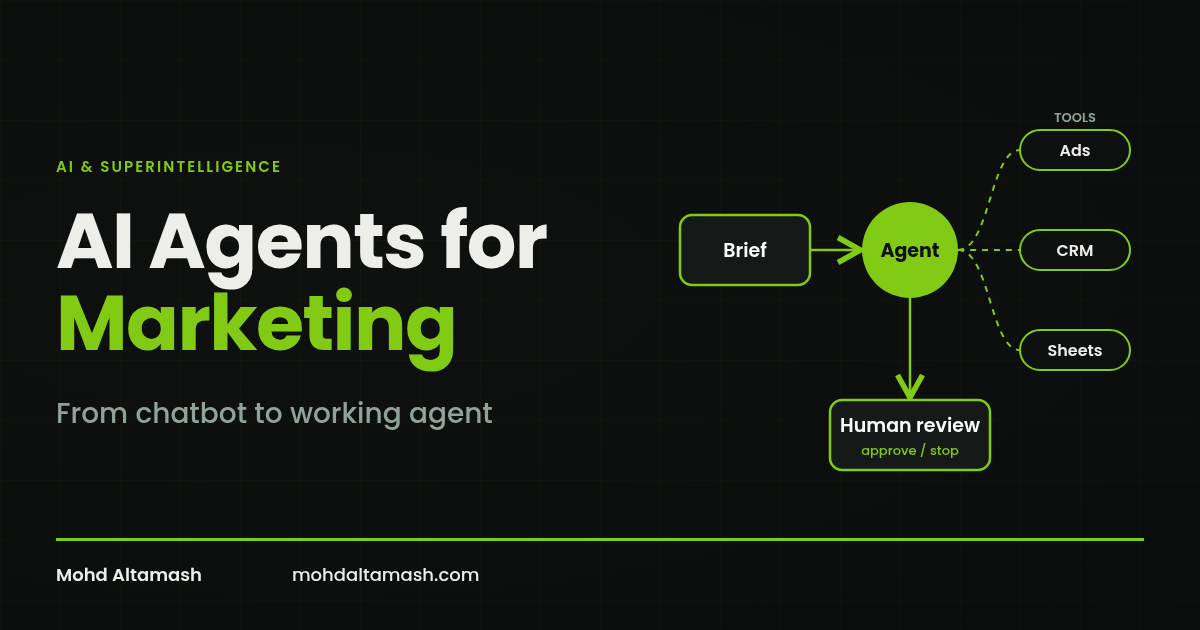
A chatbot responds. An agent acts. Ask a chatbot a question and it answers, then waits. Give an agent a goal and it breaks the goal into steps, uses tools such as search, spreadsheets, ad platform APIs or a CRM, checks the results and continues until the task is done or it needs help.
Anthropic's guide Building effective agents (December 2024) draws a useful line between two designs:
Workflows: models and tools are orchestrated through predefined steps.
Agents: the model directs its own process and decides which tools to use.
Take a weekly ad report:
A chatbot explains a spreadsheet you paste in.
A workflow pulls the approved report every Monday and summarises it.
An agent decides which extra breakdown to inspect before writing its explanation.
Anthropic recommends finding the simplest solution possible and adding complexity only when needed, and I agree. If a scheduled workflow solves the problem, don't give a model more freedom than it needs.
What are the steps between chatbots and superintelligence?#
I find it helpful to picture AI capability as a ladder. Each rung adds autonomy, and more autonomy needs more oversight.
Chatbots: answer questions and draft text when prompted.
Assistants with tools: browse, analyse files or run code inside a conversation.
Automated workflows: an AI step inside a fixed sequence, such as "new lead arrives, AI summarises it, summary goes to sales".
AI agents: given a goal, the system chooses its own steps and tools within permissions you set.
Multi-agent systems: specialised agents coordinate. One researches, one drafts and one reviews.
AGI and ASI: hypothetical systems that match humans (AGI) or far exceed them (ASI, or superintelligence). Experts disagree widely on whether and when these will arrive.
Most reliable business value today sits on rungs two to four. The ladder is a way to think, not a guaranteed path. Google DeepMind's Levels of AGI paper (2023) rates generality and performance separately, so an agent that completes one workflow well has not shown broad intelligence. The International AI Safety Report (January 2025) also notes that current AI agents still struggle with work that requires many steps.
Where do AI agents help marketers today?#
The best early uses of AI agents in marketing are repetitive, rules-based and easy to check:
Performance reporting: pull ad and analytics data, summarise changes and flag unusual spikes or drops for a person to investigate.
Competitive research: watch competitor sites, public ad libraries and pricing pages, then write a weekly digest.
Content operations: turn one long piece, such as a webinar transcript, into draft posts, emails and summaries for editing.
SEO and AEO briefs: collect the questions people ask, outline answer-first content and flag outdated pages.
Lead follow-up: confirm new enquiries on WhatsApp and email, log the source and remind sales to follow up. This is the kind of work I set up under marketing automations.
Creative variation: generate headline and copy variants that a marketer approves before launch.
In each case the agent gathers and drafts. A person makes the call. For how this fits into paid media specifically, read my guide to AI in performance marketing.
What can't AI agents do reliably yet?#
Agents inherit the weaknesses of the models behind them, and autonomy amplifies those weaknesses:
Confident factual errors: a wrong number stated as fact.
Losing track in long tasks: the agent drifts from the original goal.
Misreading vague instructions: it does what you said, not what you meant.
Because agents act, a mistake is not just a bad sentence. It can be a wrong budget change or an email sent to the wrong list.
Analysts are optimistic and cautious at the same time. In June 2025, Gartner predicted that 33% of enterprise software applications will include agentic AI by 2028, up from less than 1% in 2024. In the same release, it predicted that over 40% of agentic AI projects will be cancelled by the end of 2027 because of escalating costs, unclear business value or inadequate risk controls. Both are forecasts, not facts. Together they say adoption is coming, and poorly planned projects will fail.
What does a practical AI marketing stack look like?#
You don't need dozens of tools. In my experience, six layers cover it, and the lower layers matter most.
1. Data and metric definitions#
Start with analytics such as Google Analytics 4, a CRM and reliable conversion tracking, including server-side options like Meta's Conversions API and Google's enhanced conversions. My Meta Conversions API setup guide walks through that layer. Label platform-reported conversions separately from CRM-qualified leads. If this layer is messy, every AI tool above it produces messy results.
2. An AI assistant chosen by testing#
Pick one or two general-purpose assistants for drafting, analysis and summaries. Compare candidates on your own sample tasks: accuracy, instruction-following, privacy terms and cost. Ignore claims that one model is "best for marketing".
3. Automation and orchestration#
Tools such as Zapier, Make or n8n connect your apps and let you add AI steps to workflows. This is usually where your first marketing agent gets built.
4. Channel-native automation#
Google's Performance Max and Meta's Advantage+ already run their own machine learning. Your job is to feed them strong creative and accurate conversion signals.
5. Permissions and tool access#
Connect only what the task needs. A reporting agent gets read access to an approved dataset, not your ad accounts. Keep credentials out of prompts. Keep reporting permissions separate from publishing or spending permissions.
6. Review, logs and a stop switch#
Keep a small test set with expected answers, and run it before launch and after every change. Log sources, actions and approvals, and make it easy to switch the workflow off. NIST's Generative AI Profile (2024) lists risks such as confabulation, data privacy and information security. Turn those into tests. For example, hide an instruction inside a test document and confirm the system treats it as content, not as a command.
How do you deploy your first AI agent for marketing?#
My preferred starting point is a weekly performance commentary drafted from an approved reporting table. It is low risk, easy to check and useful from week one.
Write a one-page spec. Define the input (approved data for a stated period), the output (an internal draft with traceable figures), the owner, the success criteria and stop conditions such as missing data.
Start as a workflow. Use fixed steps first. Add decision-making only where it clearly helps.
Stay read-only. No budget changes, campaign edits or customer messages without approval.
Keep observation and explanation apart. "Cost per lead rose this week" is an observation. "Creative fatigue caused it" is a hypothesis for a person to check.
Measure honestly. Compare against the old process, including review time and software cost. A fast draft that takes as long to check has saved nothing.
Expand gradually. Once one agent is reliable, apply the lessons to the next task.
Across 100+ brands and ₹750 Crore+ in managed ad spend, the pattern I trust is simple. Automate the gathering and drafting first. Keep human judgement on money and public claims.
How do AI agents connect to AGI and superintelligence?#
Agents are not AGI, and nothing about today's tools is superintelligence. They are a step towards systems that act with more independence. The habits you build now will matter more as capabilities grow: clean data, tight permissions, human review and honest measurement. For the bigger picture, read what superintelligence means for marketers.
Key takeaways#
Chatbots respond to prompts. AI agents pursue goals by planning steps and using tools.
Most reliable value today comes from tool-using assistants, fixed workflows and narrowly scoped agents.
Good first uses: reporting, research, content operations, SEO and AEO briefs, and lead follow-up.
A practical AI marketing stack starts with clean data and ends with permissions, review and a stop switch.
Agents are today's AI, not AGI or superintelligence. Start small, keep people on money and claims, and measure.
Work with me#
If you are working out where AI agents fit in your marketing, the deployment steps above are the place to start. You can also see how I work as an AI marketing expert in India.
Sources#
Anthropic, Building effective agents, 19 December 2024.
Morris et al., Google DeepMind, Levels of AGI for Operationalizing Progress on the Path to AGI, 2023.
Bengio et al., International AI Safety Report 2025, January 2025.
Gartner, Gartner Predicts Over 40% of Agentic AI Projects Will Be Canceled by End of 2027, 25 June 2025.
NIST, AI Risk Management Framework: Generative AI Profile (NIST AI 600-1), July 2024.
Frequently asked questions
They are AI systems that take a marketing goal, plan the steps and use tools such as analytics, ad platforms or a CRM to complete it. Common uses include reporting, research, content drafts and lead follow-up.
No. A chatbot answers when prompted. An AI agent is given a goal and can plan steps, use tools and take actions to complete it, ideally within permissions you control.
Not safely without supervision. Agents can monitor performance, flag issues and suggest changes. Budget changes, new campaigns and anything public-facing should still be approved by a person.
Not necessarily. No-code tools such as Zapier, Make and n8n let marketers build AI workflows visually. Basic technical understanding helps when connecting APIs and handling data securely.
A read-only weekly performance commentary built from an approved reporting table. It is easy to check, carries little risk and shows quickly whether the setup saves time.
They add tools and autonomy, which is one ingredient experts discuss. But an agent that does one workflow well has not shown broad intelligence. Treat agents as today's AI and judge them on task results.
Related posts
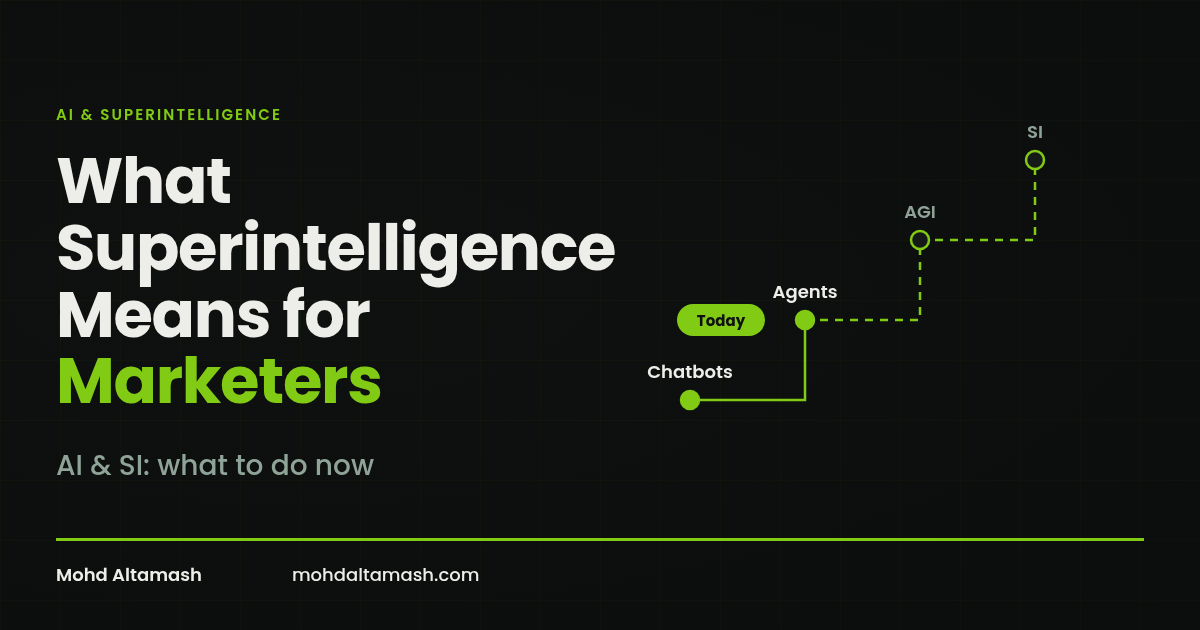
What Superintelligence Means for Marketers (and What to Do Now)
Superintelligence doesn't exist yet. Here's what it means, where experts stand, and the practical steps marketers should take with today's AI.
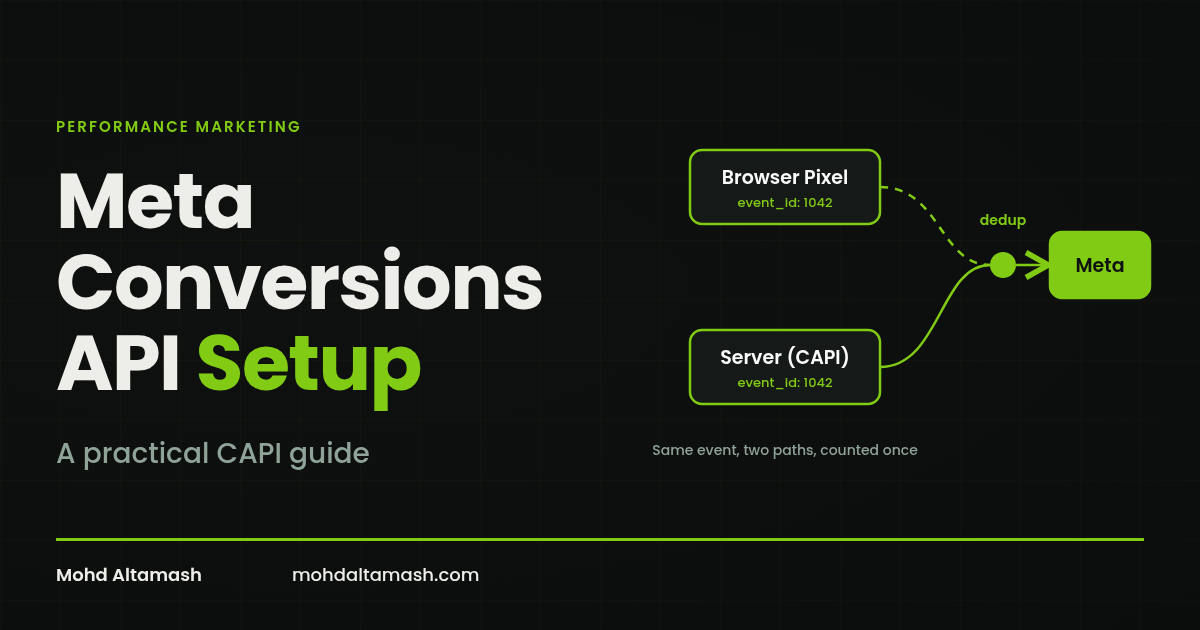
Meta Conversions API Setup: A Practical CAPI Guide
Set up Meta's Conversions API the right way: choose the events that matter, deduplicate with the Pixel, raise Event Match Quality and respect consent.
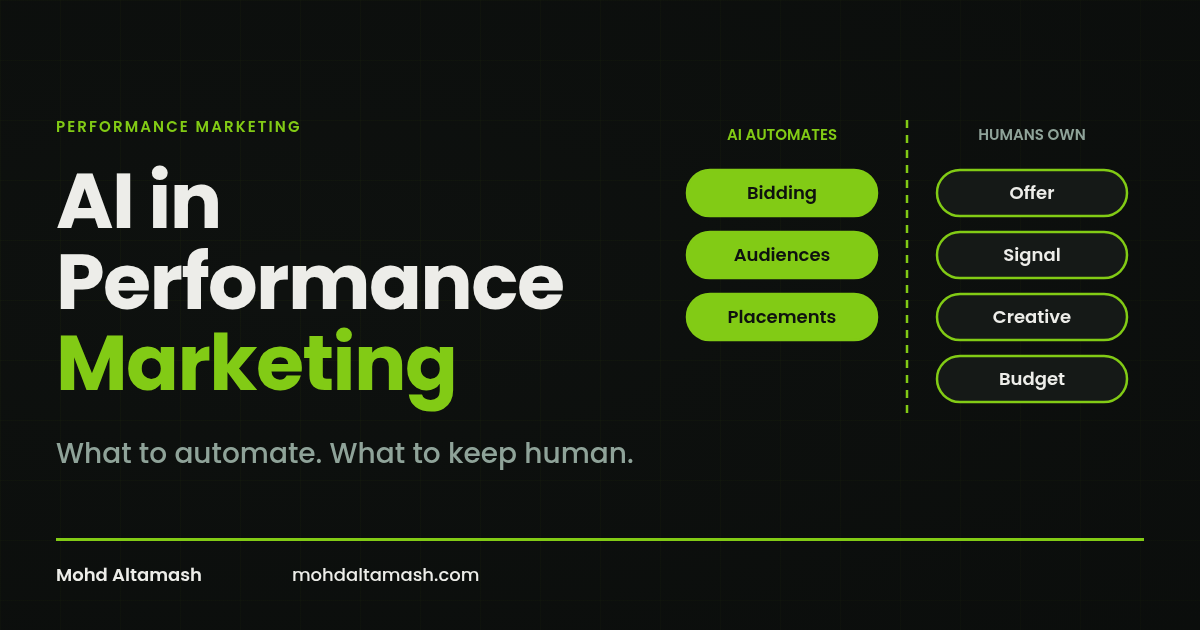
AI in Performance Marketing: What to Automate and What to Keep Human
Let AI run bidding, audiences and placements. Keep people on the offer, conversion signal, creative and budget. A practical split for Meta and Google ads.